Act I: The Illusion of Permanence
Sky and Rubble
I consulted the tide chart for the Vilano Beach area, and the time for low tide—1 PM—propitiously coincided with a brief window when the likelihood of finding cumulus clouds congregating against a contrasting darker sky was highest. This window existed just prior to an approaching storm front that threatened to envelop the sky with a flat, ashen-grey overcast layer, obscuring any striking visual elements. Additionally, the sparse foliage in the foreground was going to limit the Wood Effect—the calling card of infrared photography.
I pulled on my Chore-Cool Muck Boots, drove to the Vilano Bridge area, parked by the roadside, and climbed down the short, narrow dirt path to the marsh. The landscape below the bridge transforms as you walk outward. Access is defined by the tide; the receding water clears a path, requiring you to hop over slippery stones, wade through shallow tidal pools, and carefully avoid the shoreline muck—where even six inches of mud is enough to trap your feet.
The goal was to reach the remnants of an older bridge. Its pillars and pilings lie in repose, their bases roughened by pockmarks, looking askance at one another. Observed closely, these fragments of stone and slab remind me of a ruined Parthenon. Initially, the clouds were diffuse, and the wind further dispersed them before a storm front stalled over the area, bringing an intense downpour. Fierce winds blew the rain sideways, drenching me even as I stood sheltered beneath the massive bridge overhead. A stranded father and son out fishing kept me company. We chatted and waited. I could see a patch of clear sky eastward.
In about fifteen minutes, the rain stopped as abruptly as it had arrived. Sunlight broke through the northwest sky, and clouds huddled hastily, gathering above the ruins. A fisherman walked out from below the bridge. I composed the frame using the Schneider 120mm with an IR filter to turn the Phase One Achromatic into an infrared back, making two photographs to capture the seascape laid in front of me: fragments of stone, concrete, shells, coquina, oyster clumps, sand, pools, and muck. Looking at the shattered concrete rubble of a proud bridge that stood for decades, now resting beneath a sprawling sky, the overarching reality of entropy is impossible to ignore.
Vilano Bridge Curve
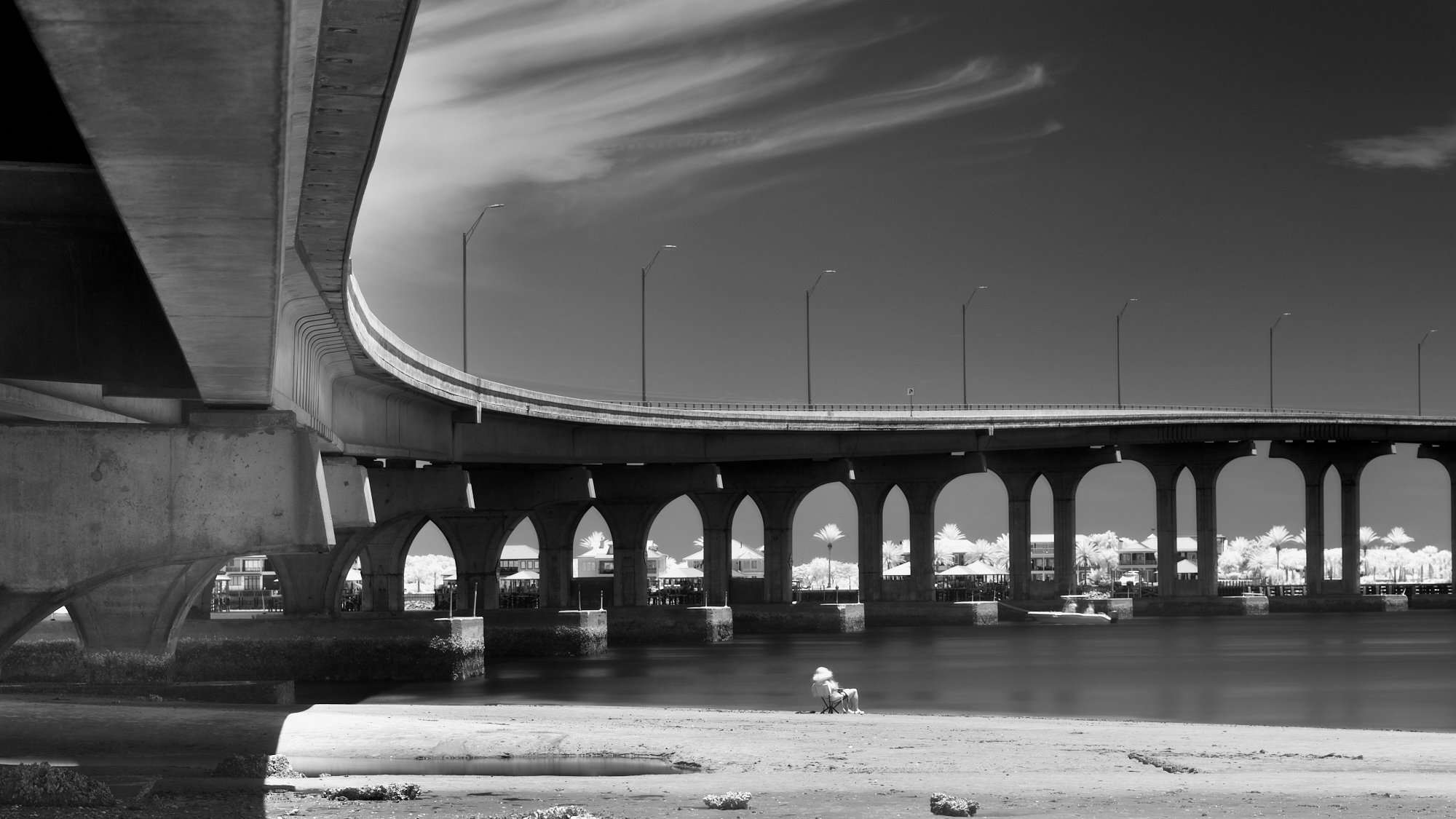
A modern bridge grew out of the stony rubbish of the old. Its gently curvilinear deck and superstructure rest on sturdy piers, rising in a sweeping arch before declining to the farther shore to connect Vilano with St. Augustine. It stands as a testimonial to our never-ceasing, increasingly ambitious "blessed rage for order"—a bid to temporarily tame the fiercely feral coastline.
A lady sat by the Tolomato River, a tidal estuary of the Intracoastal Waterway. Its waters, which had been flowing inward, had predictably changed direction as they do twice daily. The long exposure I chose blurred the flowing water below and smeared the wispy clouds above, reminiscent of the passing of time. She sat transfixed.
After composing the photograph, I wiggled my boot-clad foot side to side, loosened it, and forcefully extricated it from several inches of muck. I pulled up the tripod, unmounted the camera and slung it across my shoulder, and washed my boots and the tripod legs in the shallows where the small waves broke. Only then did I carefully navigate back to firmer ground. One must be so careful these days.
Solitary Figure Beneath the Bridge
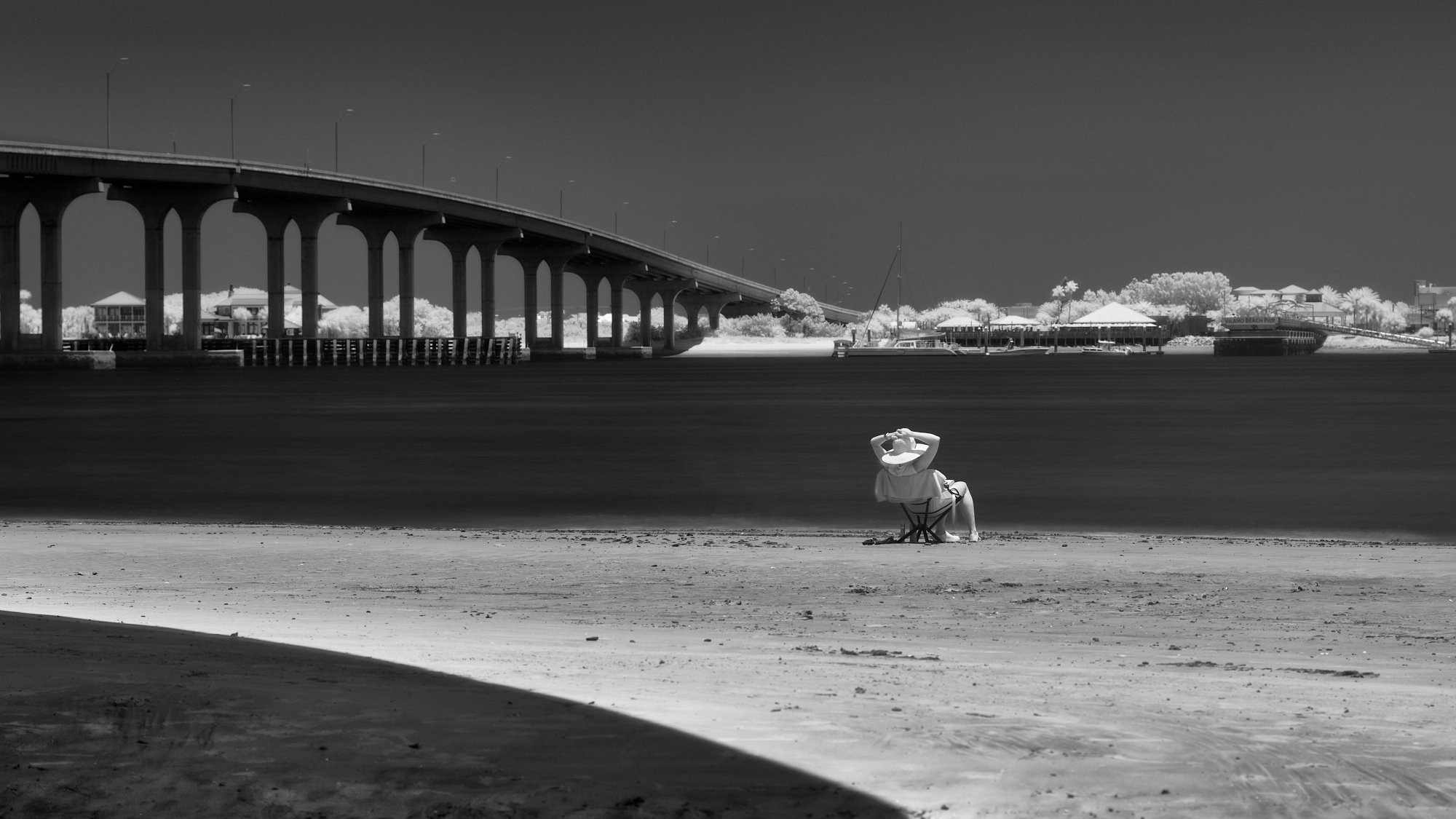
The sweet Tolomato had reversed its course, flowing away from me and leaving damp, sandy shores in its wake. A few scattered items—a small dead fish left hooked, a weathered beer can, a discarded slipper with a broken strap, a rusty Leatherman—lay as fragments of a narrative not yet told. A few hours hence, they will all be submerged. They may be buried under layers of sand, shifted downshore, or washed away entirely, replaced by other objects bearing testimony to the activities of passersby and the passed-on.
The bridge, with its stony eyes, takes it all in. Eventually, its arches will flatten, its piers will buckle, and its deck will crack. It is merely a matter of time. But for now, it provides shelter and connection to those who shall perish even sooner.
As the storm approached and the drizzle strengthened into a driving rain, I stood below the Vilano Bridge. Its massive soffit acted as a stiff umbrella above, yet left me exposed to a strengthening gale. I removed my wide-brimmed Tilley hat, placed it carefully over my Cambo technical camera with Schneider lens and Phase One digital back, and waited. In the distance, the gathered clouds grew prominent once more. A patch of pale blue appeared as the wind parted the overcast sky. The sun—hidden, though not yet set—broke through. Stark, sharp-edged shadows imposed themselves across the sandy bank once more.
I noticed the curved shadow encroaching upon the solitary figure. She stretched, leaned back, and held her pose perfectly through the three-second exposure. Standing behind the camera with the wind at my back, I watched the edges of the shadows soften and dissolve as the clouds regrouped; they were resurgent once again. The flow of time. Advancing and receding tides. Parting and gathering clouds. A solitary figure bearing witness to all of this, and I to her. Lives reflected and refracted, a snippet of ghostlier demarcations captured on a silicon sensor.
Shantih shantih shantih.
Dark Storefront Monolith

The cyclothymic climate of July in Northeast Florida yields rapidly changing weather. "If you don't like the weather," our realtor had told us fifteen years ago as we took shelter from a downpour in Publix, "wait one hour." The forecast suggested a narrow, two-hour window between 11:30 AM and 1:30 PM. This offered the highest probability of dramatic clouds and tree canopies drenched in bright sun, their chlorophyll ready to glow ghostly white in an infrared capture.
At my next stops—Davis Shores and Fort Mose Historic State Park—other monoliths stood stark against a contrasting background of foliage, water, and clouds, much as the Vilano Bridge had. The dark, unyielding geometry of a silent storefront acts as a different kind of monument. It sits as if the AllSpark had shed its alien glyphs and parked itself in St. Augustine—its furnished interior now incongruously visible, surrounded by foliage rendered ethereal and transparent by the infrared spectrum. Yet even this adamant geometry is only the illusion of permanence made solid; move toward the water's edge, and the constructed world itself begins to dissolve.
Act II: The Unreal-Real Landscape
Edgewater Inn: At the Edge of the Visible
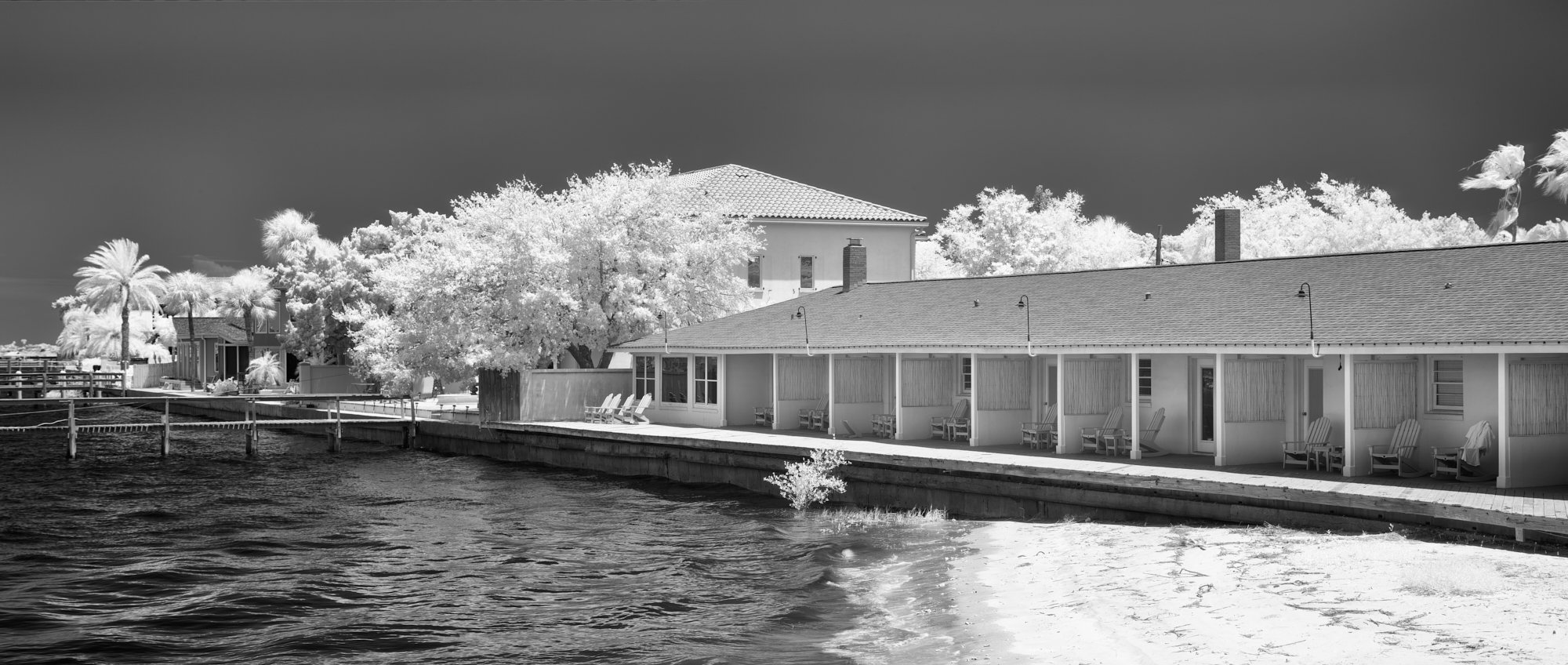
As we move toward the water's edge at the Edgewater Inn, the coastal periphery begins to feel strange. We stand at the threshold, preparing to step out of the constructed city and into the wild. Here, the surreal Wood Effect is most pronounced. This ghostly glow requires specialized equipment to capture, existing in a spectrum of light that remains entirely invisible to the biological eye.
I made these photographs using a Phase One IQ3 100MP Achromatic digital back fitted with a B+W 093 infrared filter. This combination records only deep near-infrared light—approximately 830 to 1,100 nanometers—completely bypassing the 400 to 700-nanometer range of human vision. No known animal can perceive this entire spectral range. While some species navigate via ultraviolet and others sense thermal heat, none see the deep near-infrared wavelengths recorded by this sensor.
Plants, however, interact profoundly with this light. Healthy vegetation reflects massive amounts of near-infrared energy as a function of its physiology. This causes leaves and grasses to appear luminous while the skies darken, water absorbs the radiation to become nearly black, and atmospheric haze vanishes. The resulting images reveal a hidden landscape—one shaped not by color as we know it, but by the unique reflective properties of the natural world, ordinarily accessible only through scientific instrumentation.
Human Vision Compared
| Species / System | Spectral Range / Sensitivity | Perceives 830–1,100 nm? |
|---|---|---|
| Humans | 400–700 nm (visible light) | ✗ |
| Dogs | ~400–700 nm | ✗ |
| Cats | ~400–700 nm | ✗ |
| Birds | ~320–700 nm (many species also see ultraviolet) | ✗ |
| Bees | ~300–650 nm (strong ultraviolet vision) | ✗ |
| Reindeer | May detect ultraviolet below 400 nm | ✗ |
| Some Fish | Up to ~750–800 nm | Limited (not beyond ~830 nm) |
| Pit Vipers | Visible light plus thermal sensing (8,000–14,000 nm) | ✗* |
| Vampire Bats | Visible light plus thermal sensing | ✗* |
| Octopus | Visible light only | ✗ |
| Healthy Vegetation | Strongly reflects ~700–1,300 nm (Near-Infrared) | Reflects (does not see) |
| Phase One IQ3 Achromatic + B+W 093 Filter | Captures reflected light from approximately 830–1,100 nm (Deep Near-Infrared) | ✓ |
Notes:
• Humans and most animals perceive only the visible spectrum (roughly 400–700 nm).
• Birds and bees extend into ultraviolet light, while pit vipers and vampire bats detect thermal infrared (heat) rather than reflected near-infrared light.
• Healthy plants do not "see" near-infrared light but strongly reflect it as part of their normal physiology. This high reflectance—known as the red edge—is why foliage appears bright or white in deep infrared photographs.
• The Phase One IQ3 100MP Achromatic paired with a B+W 093 (830 nm) filter records a portion of the electromagnetic spectrum that is effectively invisible to human vision and is not directly perceived by any known animal.
Winter Wonderland in a Florida Summer
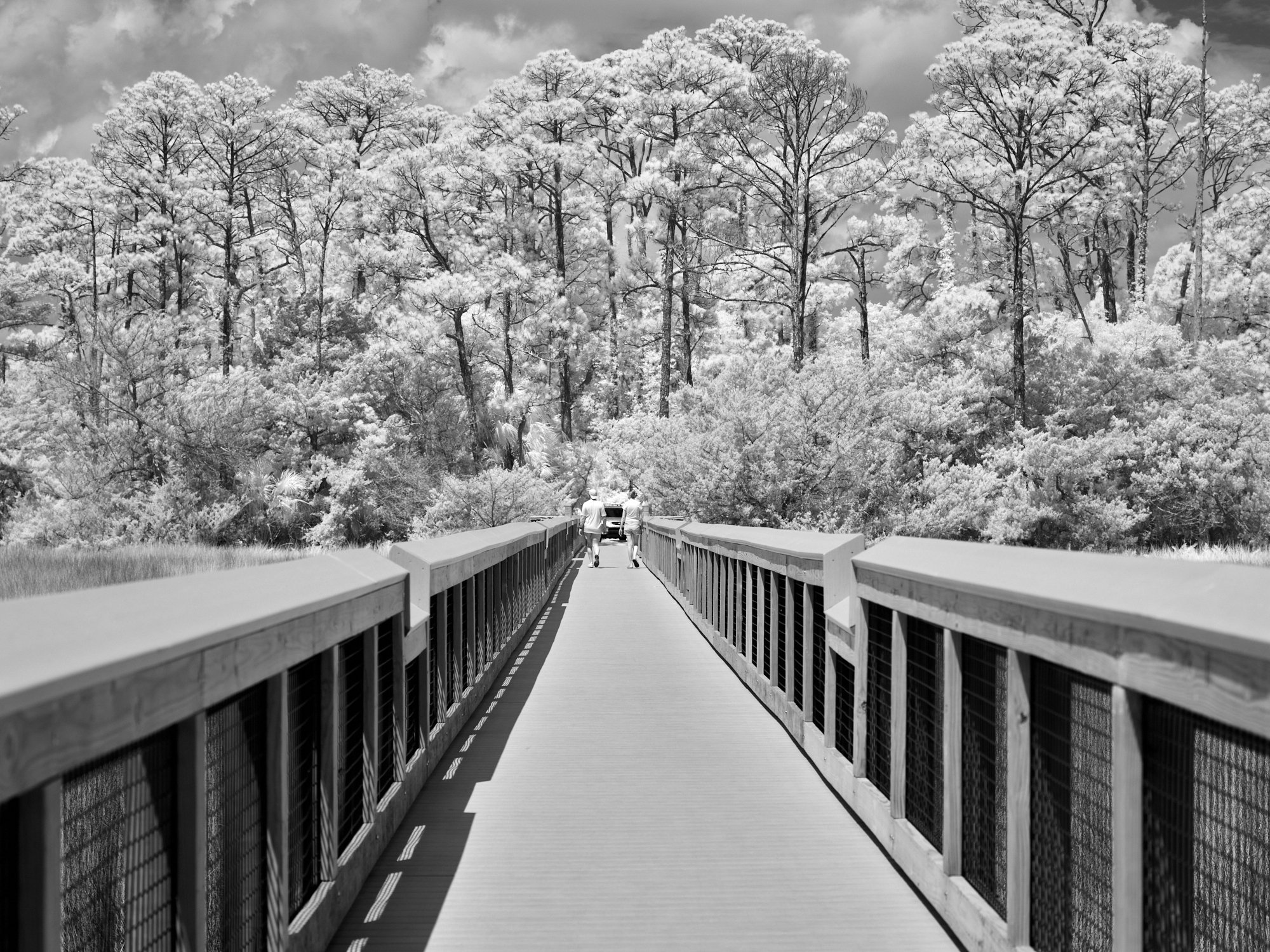
Infrared strips the comfort of the familiar right out of the landscape. As I watched figures retreat down the boardwalk at Fort Mose Historic State Park, the scene transformed into a winter expanse. I visualized them walking into a snow-covered landscape—an illusion completely divorced from the sweltering Florida reality, yet constructed entirely from the physical elements at hand. The vast dynamic range of the achromatic sensor held this mirage together, allowing me to preserve the deep, textured details in the shadows while preventing the luminous, faux-snow highlights from blowing out.
Skeletal Trunks, Luminous Canopy

Out on the edge of the marsh, the dark tree trunks stand stark against the snow-like foliage and a clouded sky. It is a disorienting, ghostly aesthetic—an unreal-real rendering of the world that resonates with the internal tumult of perceiving and interpreting rapidly evolving societies. The pace of change is relentless and our place within it ever uncertain. Here in photography, unlike real life, the surreal becomes manifest with dizzying clarity.
Ethereal Marshland

Here, in this ethereal, preserved, and deliberately untamed marshland, the landscape exists beyond normal vision.
It is a place that serves as a display of human hubris, as it seems to declare: we could have reclaimed and repurposed this land, but by choice we quarantined it within a boundary to fend off encroaching development and the condos it would have raised here.
It is a place where the act of preservation, entirely devoid of restraints elsewhere, pretends to absolve us from the guilt of committing grievous harm to the environment. It is a place where what once was common and pervasive is now special and scarce.
It is a place of Stevens' "ghostlier demarcations," where our blessed rage for order holds limited sway.
Damyata. Datta. Dayadhvam.
Act III: The Silent Guardians
Sailboat, Matanzas

Beyond the preserve, the tide carries us back among people. At the city's edge, a solitary sailboat sat tethered in the calm waters of Matanzas Bay. Its sails rolled and lowered, it swayed gently as waves, spurred by the breeze, caressed it. The bright sun glared on the digital back's screen, and I raised a Hoodman loupe to check focus and histogram. The water of the Matanzas ran a dense black on the screen, while the clouds and the boat's hull shone bright; among the chalky white foliage of the far shore, a tall cross rose above the horizon.
I felt the scene called for a guardian of these mingling waters. Uncouth and filthy, a tangled mat of hair on his chin, he squints protruding eyes set deep below a prominent brow. His dirty cloak is held by a loose knot at his shoulder, where his leathery, creased skin is barely distinguishable from the dark texture of his garb. He holds a pole, its end planted on the dock, and leans his weight against it. Sure of himself, he knows that soon he will tend the sail alone. Perhaps he is always there, toiling unseen in a realm as invisible to us as the reality revealed only in infrared. Perhaps we can only see him when we close our eyes—momentarily, or permanently.
The Bridge of Lions (diptych)


Back in the historic city, the unblinking stone lions stand watch over the tide. Their attention is unwavering yet without intent. They observe indiscriminately those who pass them by. These passersby, armed with intent and attention, often look ahead to the bridge and pass below these statues. Lookers and looked-upon are both in various stages of transformation. Stones, bones, and flesh are all slowly becoming porous, brittle, and flabby. It is merely a matter of time before these changes become obvious; slow decline stutters till each precipitately reaches journey's conclusion. For now, they stand tall.
The Fisherman & the Superyacht

For now, the sun is shining and fish are biting. The fisherman by the bridge, hoping for the latter, casts his line. From this vantage one can look across the bay toward downtown. A superyacht anchored in the St. Augustine Marina rises as high as the buildings behind it. Its sharp profile points the same way as the fisherman's hand.
Castillo Across the Bay
O you who turn the wheel and look to windward,
Consider Phlebas, who was once handsome and tall as you.
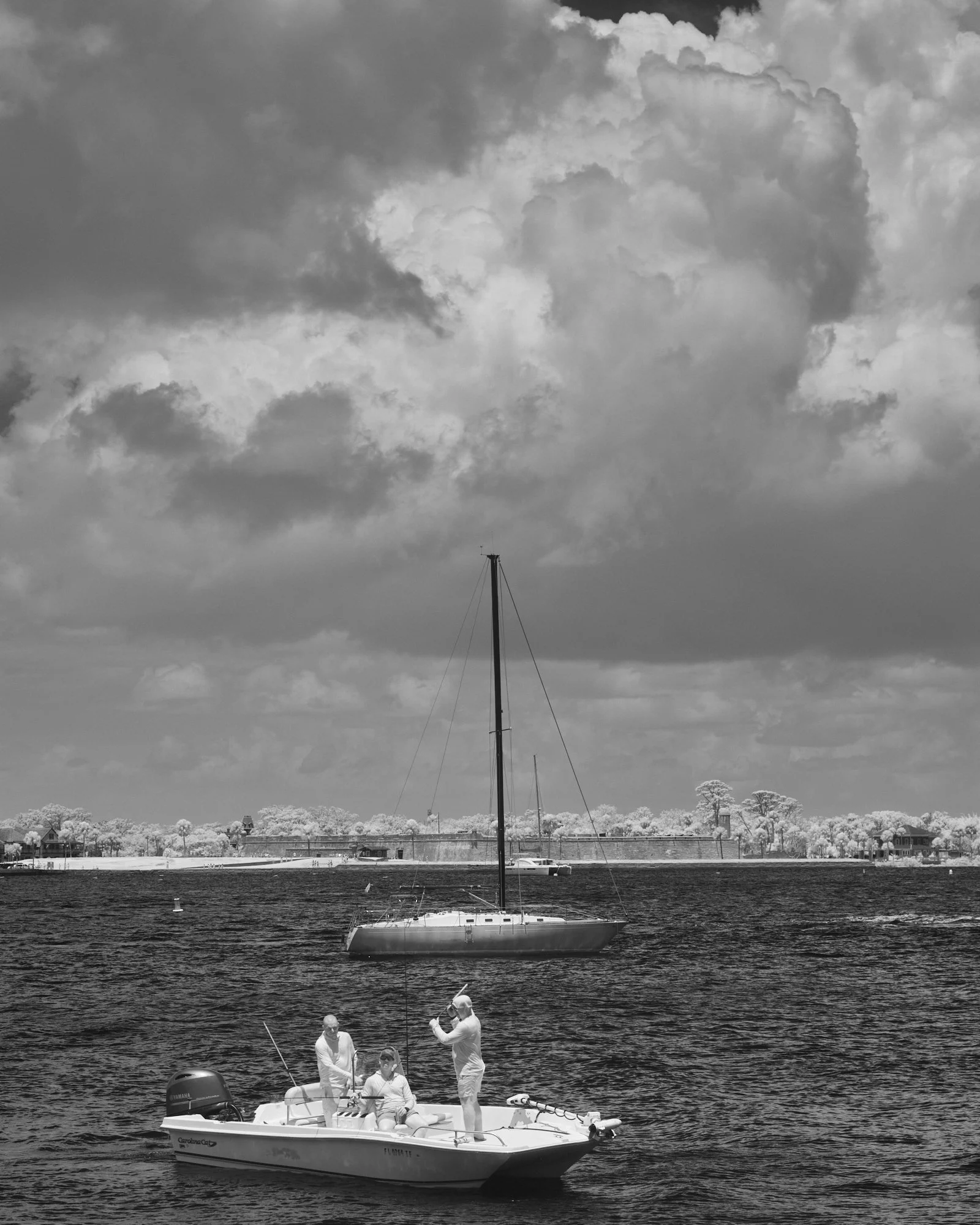
Three boats ride the bay, anchored equidistant from one another, as if set to a plan. The Castillo de San Marcos has stood for more than three centuries; when British cannon pounded it — first in 1702, then through Oglethorpe's siege of 1740—the balls sank into its soft coquina walls and stuck fast, and the attackers, watching the holes seem to close over by morning, grew spooked, certain the walls were healing themselves. And they were not entirely wrong: the Castillo endures precisely by yielding — its soft shell-stone swallowing what would shatter harder walls, outlasting the concrete that cracks and the iron that rusts. Magic or not, no traveler to St. Augustine can resist its pull.
In the foreground, distant foliage and three fishermen—each with his rod, aboard the Carolina Cart—glow in the glorious infrared against the dark of sky and water. This moment, when the three gazed in three different directions, has since passed; the photograph alone preserves the sliver. In this decisive moment the attention and intent of the observed and the observer meet, and are fixed, forever, in a single frame.
Phlebas the Phoenician, a fortnight dead,
Forgot the cry of gulls, and the deep sea swell
And the profit and loss.
A current under sea
Picked his bones in whispers. As he rose and fell
He passed the stages of his age and youth
Entering the whirlpool.
— T. S. Eliot, "Death by Water," The Waste Land
Technical Apparata
Digital Back — Phase One IQ3 100MP Achromatic | Technical Camera — Cambo WRS-1600 | Lens — Schneider-Kreuznach 120mm f/5.6 Apo-Digitar M | Filtration — B+W 830/093 IR Black Red MRC Basic Filter (blocks wavelengths below 830 nm)
A note on method: every frame in this essay was made on a single system. The Achromatic back records no colour, only luminance; the 830/093 filter passes deep near-infrared light in the ~830–1,100 nm range while blocking the entire visible spectrum. Healthy vegetation reflects this light strongly (the "red edge"), which is why foliage glows snow-bright while skies darken and water absorbs to near-black. The effect is recorded at the sensor, not added afterward — a portion of the electromagnetic spectrum invisible to human vision and unperceived by any known animal.