One Sun Over All of Them: Kingsley Plantation in Infrared
I saw in Plantation a live-oak growing,
All alone stood it and the moss hung down from the branches,
Without any companion it grew there uttering resilient leaves of dark green,
And its look, stoic, solemn, and unbending, reminded me of those who labored here and were held.
— after Walt Whitman, "I Saw in Louisiana a Live-Oak Growing"
Kingsley Plantation sits at the northern tip of Fort George Island, where the St. Johns River broadens into tidal marsh on its way to the Atlantic. The island has been many things. The Timucua left their shell mounds here six thousand years ago. The Spanish raised a mission, San Juan del Puerto, and named the waters for a saint. The British came in 1765 and planted indigo; the Spanish took it back; then the Americans. A plantation was established on the island and cycled through owners the way a house cycles through tenants — McQueen, McIntosh, and then, for twenty-five years and the longest tenure of all, Zephaniah Kingsley, whose name the place still carries. It was once a thousand acres. The forest has since reclaimed all but sixty, and those sixty are kept now as a preserved park.
To reach it you drive north out of Jacksonville on 295. The downtown thins behind you — a handful of tall buildings, then none. You cross the Napoleon Bonaparte Broward Bridge, its cables fanned like sails: the dry port to your left, the power plant to your right, the water below. Coming down the far side, the shipping cranes fall behind. You exit onto State Road 105, and the land goes over to pine and live oak and the broad, flat presence of water. The road bends east along the St. Johns, though the river is seldom fully seen. It shows itself in pieces: a widening of sky beyond the trees, a glint through the palmetto, the smell of salt carried inland.
The river is tired here, near the end of its journey. It has come more than three hundred miles across Florida and fallen barely thirty feet. Now the Atlantic presses in on it twice a day, pushing salt water upstream; the sluggish freshwater retreats but cannot escape. It splutters, acquiesces, intermingles, and now and then pushes back. The two do not settle. Marsh spreads where the water gives ground. Creeks open without warning and close again in the cordgrass. Fresh water and seawater mix in proportions that change with the tide, and by the time it reaches the Atlantic it is both. One channel, two waters, meeting the same end — the ocean, the most primal of all, the beginning of everything that lives.
Fort George River is born of that mixing — less a separate river than a tidal arm of the St. Johns, fed by the same brackish water. It is this river the plantation faces, and it is this river you will meet again along its edge. For now, the causeway carries you across onto Fort George Island, and you turn off toward the plantation, down an unpaved one-way road that narrows into the woods. Native trees crowd both shoulders and arch overhead, branches from either side reaching toward each other across the divide. You drive slowly, watching for oncoming cars, each one throwing up a white plume of fine dust that swallows the road ahead. You swerve the potholes, edge right to let others pass, take the curves, and arrive at the entrance gate. A strip of land has been cleared for the peculiar buildings that extend in an arc on either side, with a pull-off of dirt for a handful of cars. The road goes on to a larger lot, and beyond it the forest opens onto sixty acres of cleared ground, bounded by the Fort George River on one side and woods on all the others.
It is quiet out there. You can hear the mosquitoes swarm and buzz around you. You can hear your own steps over the dead branches and fallen leaves that that rot down into the ground and feed its insects. I have heard birds in the trees but seen few of them. Herons stand in the shallows past the boundary, where the brackish water runs. The light comes off the water of the Fort George River, flat and white, and it bathes them all — the smooth white board of the houses, the textured white of the barn, the rough tabby of the cabins beyond. The sun glares from above, and its light filters through the canopy and lays pockets of brightness on the ground, stark against the dark that the same light throws down beside them. Same source; two distinct shades.
The buildings themselves were raised and cared for according to the rank of their residents. A fence now separates the last owners' grand dwellings, the garden, and the barn at one end from the ruins of the slave quarters at the other. What remains on those sixty acres is compact, and deceptively banal: the oldest plantation house still standing in Florida, an attached kitchen house, a tabby barn, and the ruins of twenty-five slave cabins set in a long arc — one of the best-preserved such rows in the United States. The principal business conducted here was not cotton, or sugar. It was people: the buying, the selling, and the training of human beings, who commanded a premium at market, prized for their skill at building and growing. This ground was a port of the trade as much as a farm — Kingsley kept a fleet of slave schooners, some built in a yard on the island itself, and they landed their African cargoes here, openly until Florida became American in 1821, and in secret after. Cotton, the cash crop made lucrative by that unpaid labor, was a sideline. Later the cabins would be shown to hotel guests as a curiosity. Later still the State of Florida would buy the property, in 1955, and the National Park Service would take it over in 1991, and it would become what it is now — a preserved place, looked after, where a dark chapter of our history is told, but told in an order each visitor develops for themselves.
For a plantation that keeps a stain on the record of all humanity, it is remarkably compact. It asks difficult questions of its visitors and answers none of them at once; it keeps its answers, the way a book keeps them for the end of the chapter. But at first, it scatters the pieces of a complex puzzle, and hands them to you with no picture to assemble them by.
Begin, then, with the oldest piece — a tree.
In the beginning, after the light, there were trees. As a lineage they are unfathomably old — the first of them stood more than 380 million years before any human walked the ground beneath them — and though this singular live oak is young by that measure, it keeps the ways of the old: it outlasts nearly everything that happens around it, and it remembers.
Start with this one, because it was here before there was a plantation, and saw what the plantation became.
It watched the tenants arrive and fail in their turn. It watched John McQueen come north out of debt and Spanish grants, planting Sea Island cotton with three hundred enslaved people, and it watched his fortune collapse — until, in 1804, he sold the island and hired out the people he had enslaved along with it, a hundred and twenty dollars the head. It stood through McIntosh's decade and his flight after a failed rebellion. It was still standing when Zephaniah Kingsley moved onto the island in 1814, and when he bought it outright three years later, and while the sixty enslaved people who worked beneath its branches raised another man's wealth.
The tree took it all in — the horrors, the tedium, the ordinary passage of the days. If it was repulsed, if it protested, its lamentations are lost to the wind. If it cried, the tears were washed away in the rain. If it grieved, or later found some reason to rejoice, it kept that to itself. It was already old when the first walls went up. It was older when they fell. Across all of it, the tree has done the one thing the bonded workers who stole a moment to rest or leaned against it or sat beneath it were forbidden to do: to belong entirely to itself, to root in the ground below and call that patch of earth its own.
The tree is the easiest piece — it asks nothing of us. The rest do. Each piece of this living puzzle, like a three-dimensional shape, will fit others in more than one combination, and the individual pieces stay irreducible. Each assembler brings a preformed mental model, or lets the pieces find their own order, and the finished artifact takes a unique shape in every mind. One place. Many meanings.
As we each shape our schemas, to stay faithful to this ground and its place in history, we must carry two truths in a single frame. The same refulgent light that now renders these live oaks and tabby walls into a silver reverie once fell on this pastoral land and blessed it with fertility, and also scorched the people who were owned here to work it. Beauty and plenty once shared this ground with bondage and privation. The sun, rising and setting, saw one people on one land; the people themselves lived worlds apart. Bounty for a few; misery for the many.
That is the difficulty of the place, and of these pictures. Its sylvan setting belies its blighted past. The banality of the structures that remain, without any telling of the horrors that unfolded here, is meaningless. It is we, the visitors, who assign the meaning, through our acts of omission and commission. May the future neither repeat its history nor rhyme with it.
Down the tree line the walls begin — roofless squares and rectangles, the first thing a visitor sees to left and right after the gate opens at nine. They are quietly present; surrounded by trees and shrubs, they still refuse to go unnoticed. And yet, without knowing what these remnants are and represent, one does not feel much before them. It is like watching a figure walk a dim alley with the sound cut off: the same footage a score would render ominous, or tender, or festive — depending on the filmmaker's intent — plays instead as a stimulus without a response. Context is the difference between an object and its meaning, and these cabins arrive without an accompanying score. That is the first difficulty.
The second is that their plain linear arrangement makes it hard to see how singular they are. They look peculiar but ordinary. No murals adorn them. And yet they are an archaeological treasure — the ruins of the slave quarters of Kingsley Plantation, and the largest surviving collection of standing tabby slave dwellings in the United States.
What survives at Kingsley survives as texture and geometry — a row of pale rectangles receding into the glow, handsome the way any ruin is handsome once history has congealed into composition. The eye wants to read them as a colonnade, as the bones of something classical. The knowing mind reads them as something else: rooms that kept nothing when they had roofs and doors, and now, roofless, they are all that shelters the memory of those lives.
Zoom in on the ruined remains of one dwelling, lifted out of the arc, and the abstraction thins. The engineering deserves the admiration it invites: these walls have stood two centuries in a climate that takes ordinary wood back into the ground within a generation. A window, a lintel still holding its line. Lower down, a small dark socket that once secured a beam; in the crown, the notch where a roof once rested. A door that shut against the dark, as if a door could keep the world outside. Within, a fire banked for the night once crackled, throwing light on tired faces and casting shadows across the unadorned walls, and the smell of woodsmoke mixed with spice, with stores, with sweat.
The walls endured because they were built to endure—by hands compelled to the work, who honored the craft even so. Builders who could not leave their names in the mortar, nor choose whether to build at all. And yet within these structures people found ways to endure anyway, to steal back moments of family, of short-lived joy. Those moments left no record. They survive only if we remember and recount them.
Then the light shifts, and the tabby walls of a larger cabin turn incandescent beneath a canopy gone almost black — the built thing blazing while the living things darken over it. The lens only transmits; the sensor behind it records reflectance and assigns no value to what it registers. Our eyes do the same intake — but our minds, unlike any sensor, cannot leave the scene unjudged. The fast, intuitive read arrives first and unbidden: brightness must mean innocence, shadow its opposite. It takes the slower, more deliberate mind to refuse that, and refusing it is exactly what this place asks — demands — of everyone who comes to look. The scene is bucolic and stripped of its history it looks at peace. What it stands for is another fact entirely.
Diptych
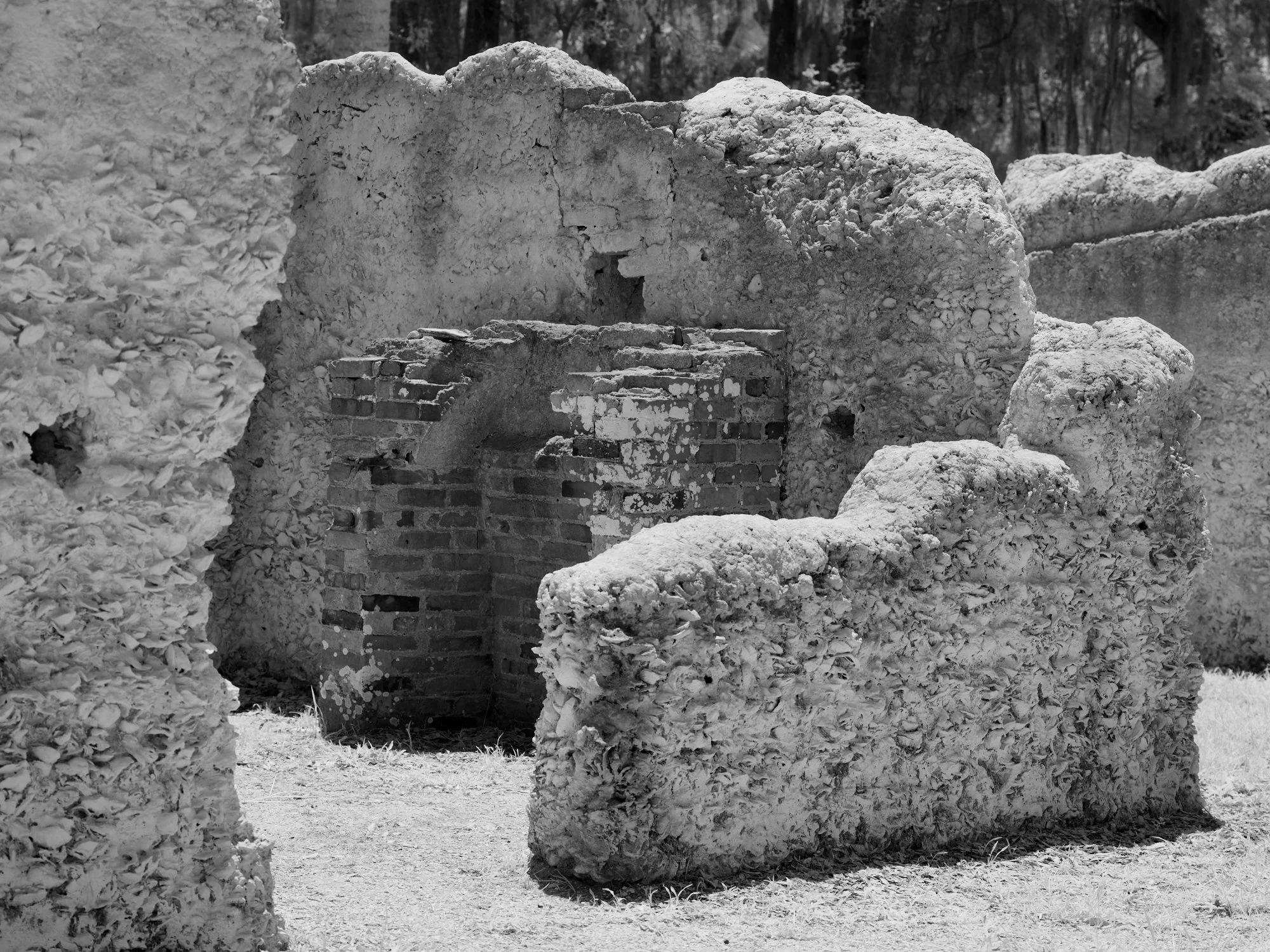
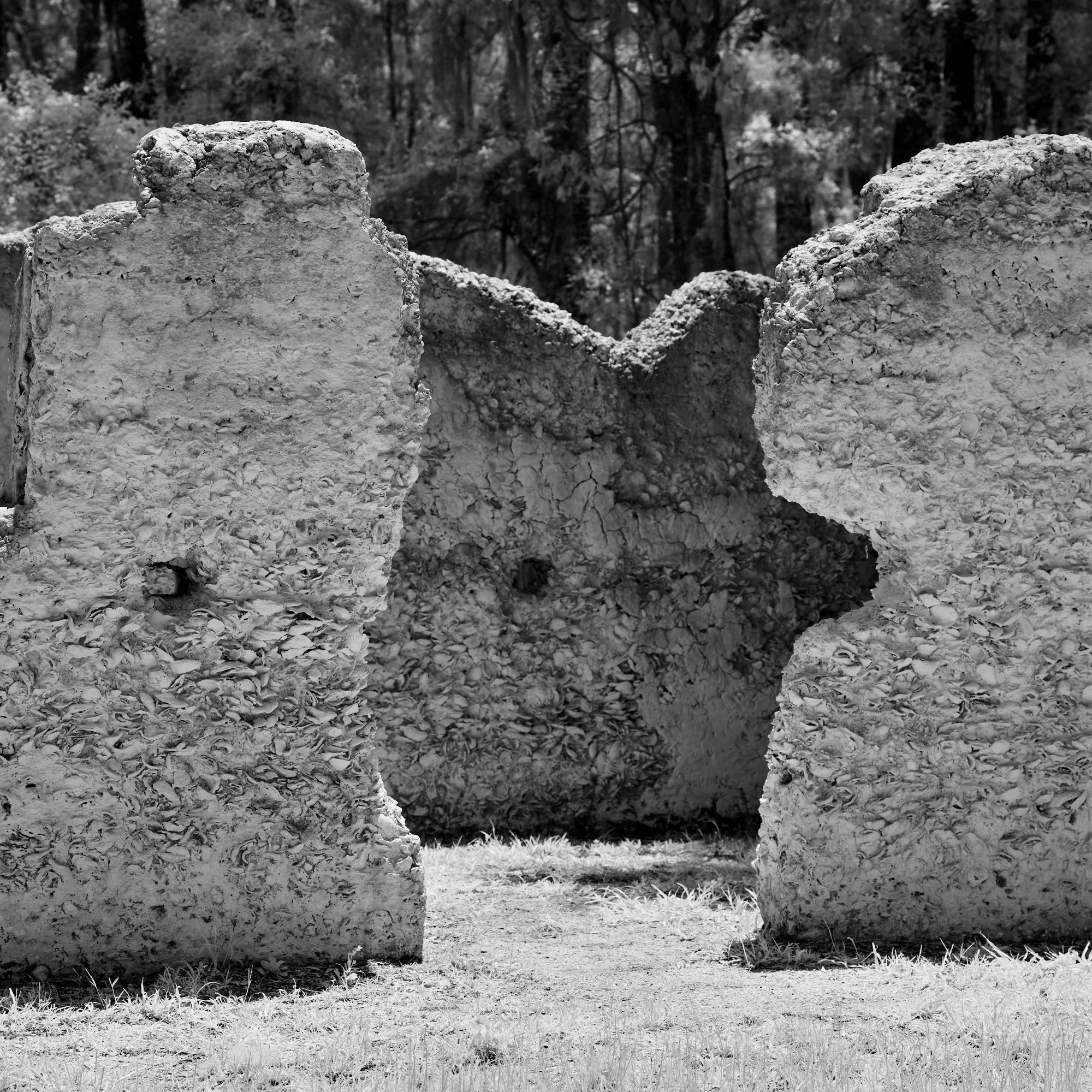
Come closer and the wall stops being architecture and becomes its own strange substance. This is tabby — a concrete with no single origin. The enslaved raised these walls through the 1820s, burning oyster shell from ancient middens (mounds built up over thousands of years from the meals of the Timucua and the peoples before them) into lime, slaking it with water, binding it with sand and yet more shell, and pouring the mix course by course into wooden forms. Where the tabby has sloughed away, the brick throat of a hearth shows through, laid patiently by hand — the fire the whole dwelling was arranged around. Unlike the wooden quarters common farther north, tabby resisted termite and rot and fire and the humid Florida air, which is why twenty-five of the original thirty-two still stand — the largest surviving collection of tabby slave dwellings in the country.
The shells hold the presence of the Indigenous dead; the technique echoes building traditions of both West Africa and the coastal Southeast; the walls carry the knowledge and the forced labor of the people who poured them. Several cultures, set in one substance. And the cabins were ranged in a wide arc — sixteen to a side — a shape that recalls the villages of West Africa and, not by accident, let the household at the great house keep the whole settlement in view.
We walk up to the threshold. Another cabin, seen straight on but not yet crossed. The doorway stands open — and it is as if the remains of the cabin glare back at you, straight into your eyes, unflinching, holding your gaze. Stand here long enough and the mind drifts to how a family once passed through this door each night and could call neither the door, nor the room behind it, nor one another, their own. To hold a threshold is to hold a small sovereignty — this is mine, you may not cross — and that was the one thing the people here were denied.
Before I walk on, one last living thing stops me. A cedar — or what the years have left of one — leaning nearly sixty degrees to the right, its roots somehow robust enough to hold it from tumbling over. Its trunk is rickety, dark, and scarred, set against a wall of foliage burned white by the same light that leaves the tree in shadow. Everything I have seen so far has outlasted the people who made and tended it: walls that outlasted their builders, a majestic old moss-laden oak, and now this cedar — seemingly indifferent witnesses to all of it. It leans there at the edge of everything, scarred and still standing, a sturdy yet weathered body caught in the act of falling. It has stood tall; now it tilts, vulnerable. Will the next storm be the end of it? Beyond this tree the ground opens onto the house on the water.
Triptych
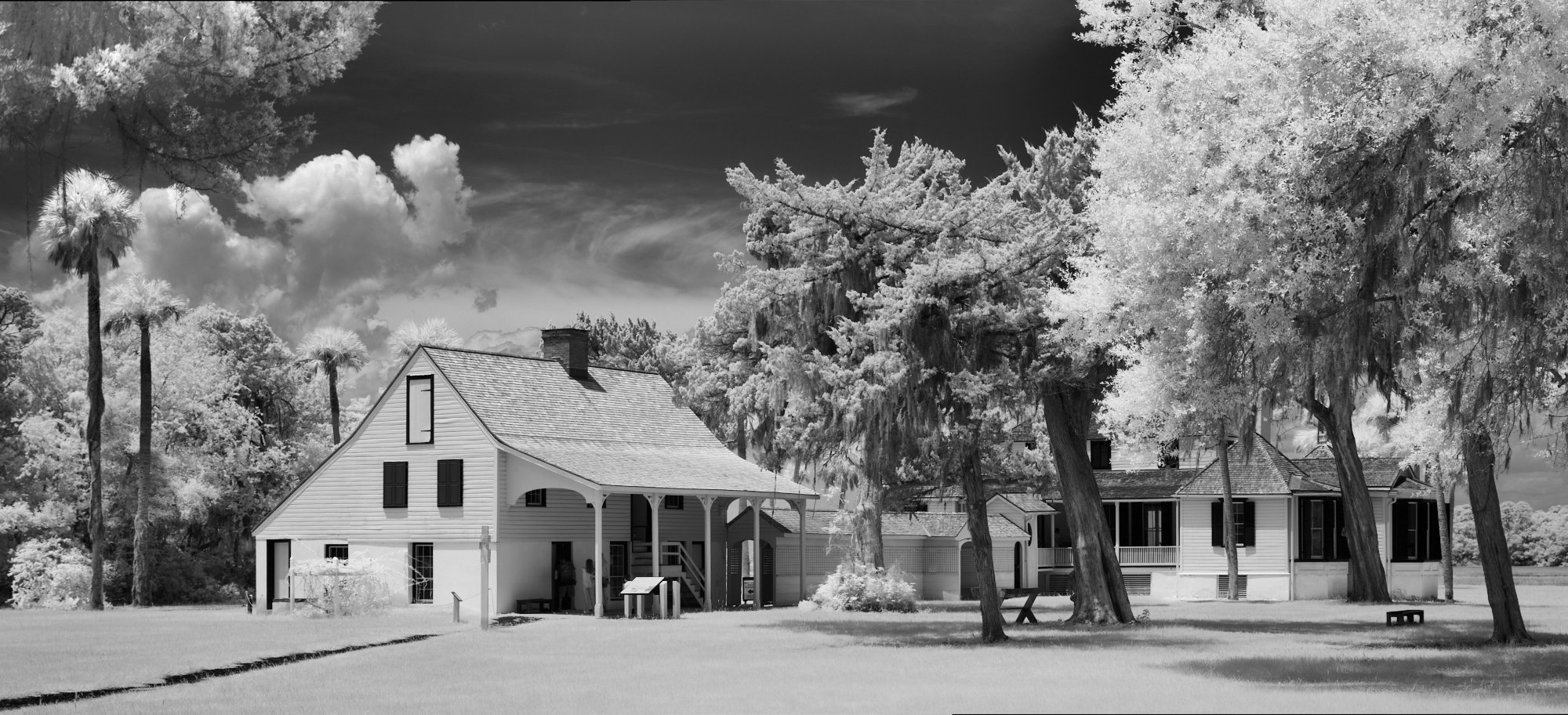
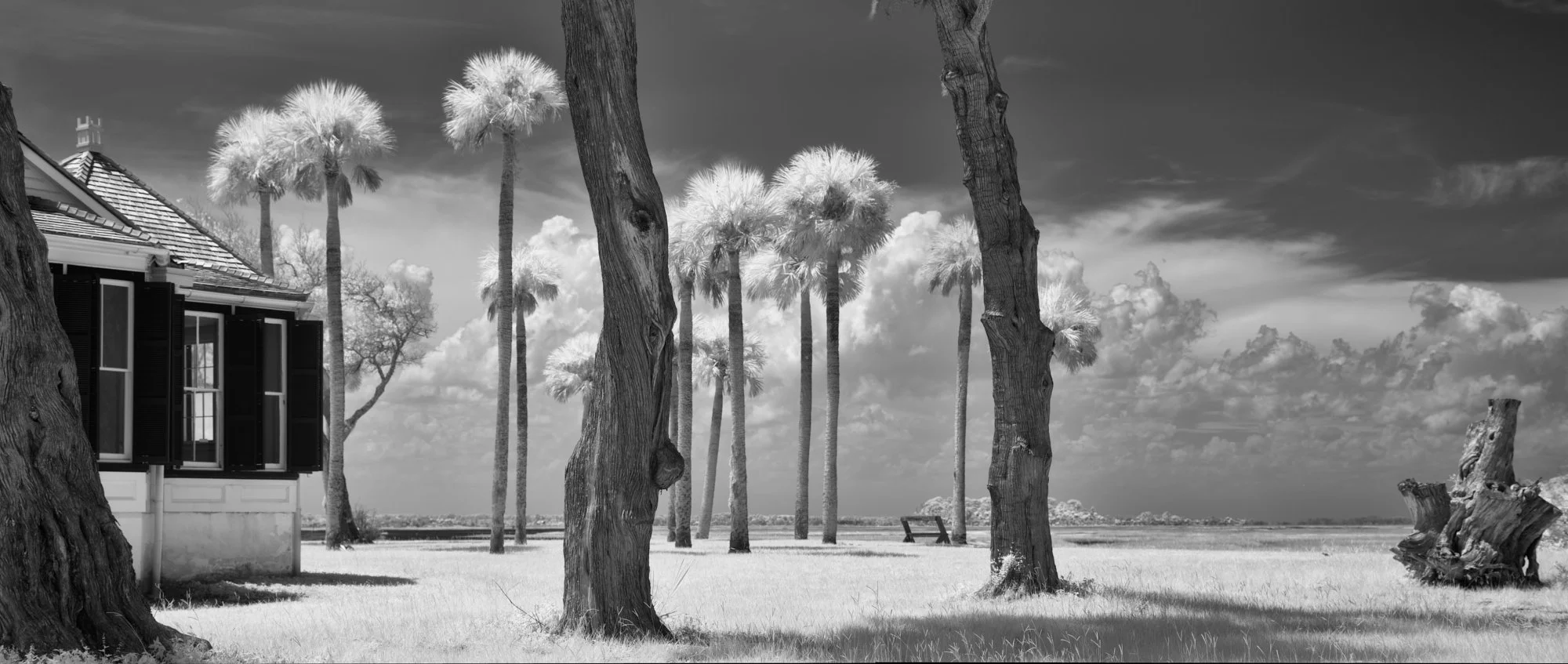
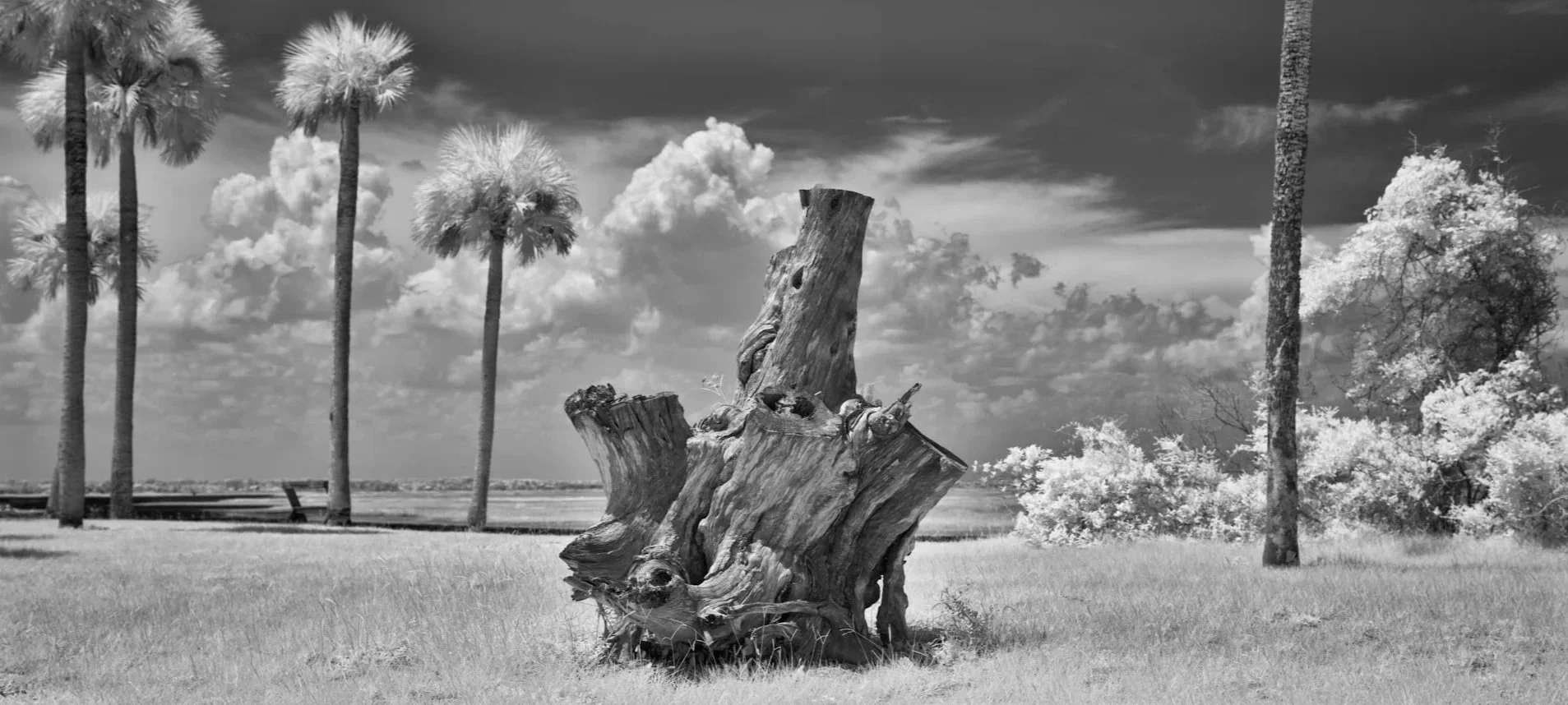
A short drive — a minute, no more — away from the cabins you pull into the parking area beside informational signs, step out, and the plantation presents its other side. To take it all in you must move your head from one side to the other, like sitting in the front row of an iMAX theater.
To your left, the house: white, shuttered, intact, the roof sound, the porch deep in shade. To your right, two connected barns, where the work was kept. And ahead, between the two, the ground runs down through a file of palms and one leaning cedar to the stumps, and past the stumps to the water, flat and bright and indifferent, holding the far shore in a thin silver line.
Look one way and it is a handsome Southern estate under a magnificent sky. Look the other and the displays in the barn tell how this affluence was wrung from enslaved labor, unpaid and unfree. Turn your head slowly from the barn toward the water and the house slides out of the frame, the palms take over, and where your eye finally rests is a stump — stout and tortuous, its weathered and bleached bark coruscating in the light. The pieces of a complex puzzle. Their staid facades and stately presence make it difficult for a casual onlooker to decipher what this tableau truly means. It is only when one reads the displays inside the barn, and scattered around the grounds, that a reference image emerges. For those who wish to put the pieces together, the clues are there.
So we go in.
We turn to the right, toward the barns, walk around, and look in. Mosquitoes swarm my head; thick shrub and ground cover fill the gaps between the tall palms and cedars, a few old oaks scattered behind me. The near door stands open, its white shutters folded back. Inside, in the shadow, a few weathered benches wait on a swept floor, and the far opening frames the field again, fulgent in the high-noon sun. Two thresholds, and the blazing light at each end of the dark between. Light, then dark, then light again — the refrain the whole place keeps: there is light beyond this darkness, and the only way to the far side is through it.
So we go in.
Inside, the walls are hung with the history that the ruins, scattered in their arc, allude to but never explain. The place trusts its visitors; it turns those who look, and learn what the days here held, into witnesses. The memory must be kept, and here, inside the two connected barns, the remaining pieces are on stark display.
To your left, a panel in two parts: Zephaniah Kingsley — A Respectable Business, and beside it Rights of Blacks, Free and Enslaved. Beneath those measured words, the images. Men and women bent in the field. One of them standing tall, arms raised — in agony, or in protest? — as the whip comes down. A capitol building, a flag aflutter on the dome. A well-dressed man on horseback — top hat, a whip beneath his arm, one hand extended toward a line of shackled, bare-chested men, as if presenting them for sale. A schooner idles in the bay behind them. To your right, another pair: Plantation Agriculture: Land, Seed, and Forced Labor, and Life of Bondage, Life of Wealth.
The reference image for the puzzle of this place begins to emerge, like an exposed print surfacing in the developer tray.
Between the panels, in the middle of the wall, sits a heavy iron bowl, wide as a bathtub, for boiling cane down to sugar. There is the whole economy crystallized in a single vessel. To fill it, the cane had to be cut and hauled and crushed and pressed, the juice strained and skimmed and boiled and boiled again, cooled and dried and graded and weighed and sacked and stitched and loaded and carried off — and every verb of it was done by hand, in heat, without pay, without end, and without consent. The sugar went to the trade and to the few who lived in the white house by the water, and to houses like it, far and near. What was left, the molasses, went to the many who grew the cane, cut it, and fed it to the fire. They raised the wealth. They kept the residue. And they did all of it as people the law would not consent to count as people.
We stand a while in that graded shadow, lit unevenly by the doors open at either end. Then the far one, still bright, draws us back out — toward the house, and the water behind it.
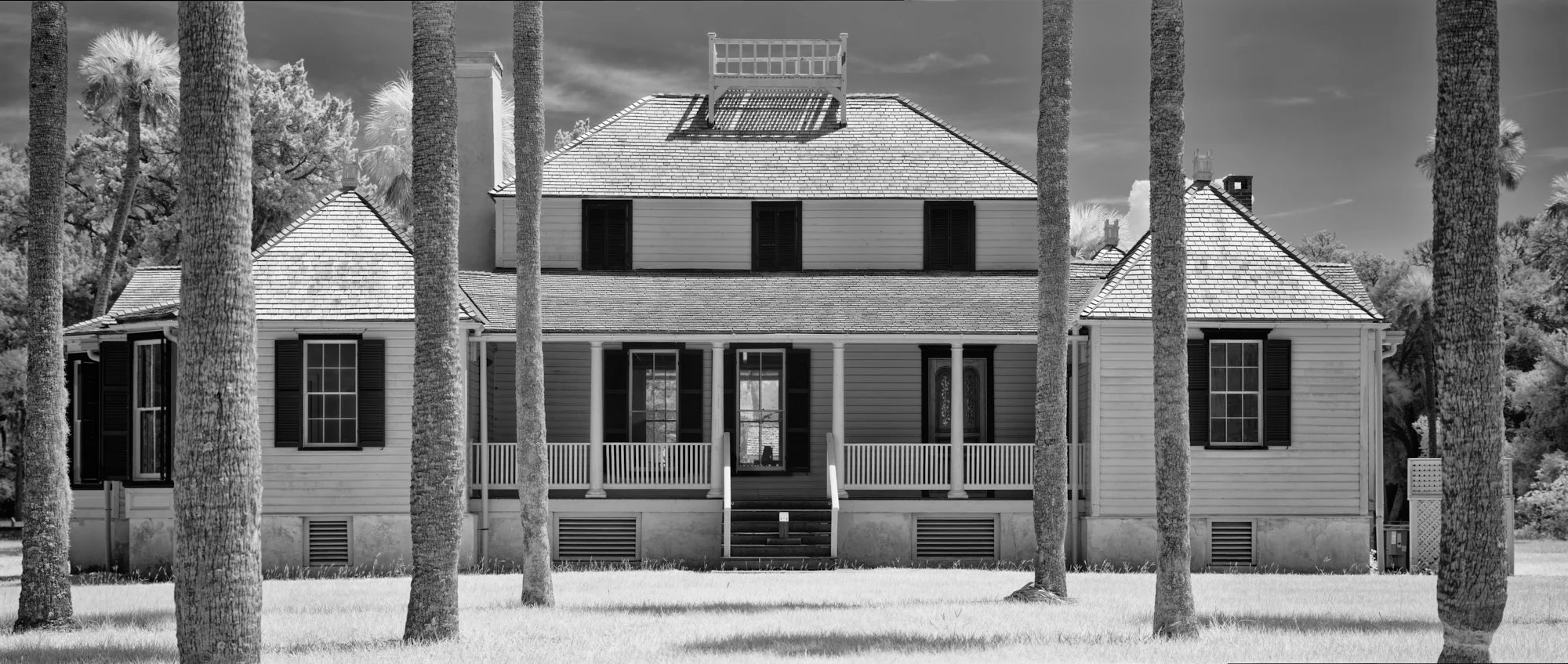
The house stands stolid, glaring at intruders with its many black eyes. Solid palm trunks rise straight and high between you and it, like a guard. The porch is wide and white and deep, inviting to a select few, intimidating to the many who lived here. The building is fine timber, its walls sturdy and painted white, its roof whole, its shutters sound. It has the appearance of a thing that was cared for.
Two hundred yards back, the cabins stand in their arc. The quarters and the grand house sit on the same ground, on the same soil, bathed by the same sun, then and now. Yet they were, and remain, worlds apart. Back there, away from the stately dwelling, the tabby walls stand without windows or doors — dozens of people once huddled inside each, their bodies in various stages of being broken. We know neither their names nor much of their lives. These cabins have no roofs. They have no eyes to stare back. They stand together in an arc, like a raised eyebrow, and hold us in a steady gaze. They open to the heavens. The pleas and prayers of the people inside went unheard then, and hover still.
This is chiaroscuro — light and shadow sharing one frame. And the temptation here, before the handsome house, is to let the borders soften in the other direction too: black and white, free and bound, right and wrong. This land, and what it stands for, and who stood on it, resists caricature. But the borders do not soften into comfort.
Consider the man who built the wealth. Zephaniah Kingsley was a slave trader who bought and worked human beings. He also published a treatise arguing for the rights of free Black people and urging masters to treat the enslaved humanely — not out of mercy, but because, he reasoned, a contented laborer produced more. He is not made better by the thought he gave it. He is made worse. Cruelty is one thing; cruelty reasoned, optimized, written down and defended in print is another. Near the end of his life, asked by the abolitionist Lydia Maria Child whether the world might come to see a slave trader as it saw a pirate, he did not flinch. Slave trading, he told her, had been a respectable business when he was young; the first merchants of England and America had done it. "I never conceal anything." And the softer defense, the one he shared with every slaveholder who ever loved someone he owned, has never gone out of use either: how could I be a bad man? I house them, I feed them, I treat them "humanely"; my own wife was one of them. The argument has worn many faces before and since. It has never once been true.
And consider the woman of the house. Anna Madgigine Jai was taken from Senegal at thirteen, sold in Havana, bought by Kingsley, and "married" to the man who owned her — a word that cannot mean what it usually means when one party is the property of the other. He freed her; she ran his plantations; and after his death she became a planter and a slaveholder in her own right, a free Black woman who owned other Black people. It would be easier if her story bent toward triumph, or toward tragedy. It bends toward neither. It shows something worse than either: a system so total that survival inside it could require becoming its instrument — a system that could take a captured child and, through the only doors it left open, make her an owner of the captured. There is a theory, and no way now to prove it, that it was Anna who set the cabins in their arc — the curved village of West Africa, where she was born, with the ruling family at its center. If so, the shape the whole plantation is remembered by was drawn by a woman who had crossed the ocean in chains and come out the other side holding the whip. Moral corruption is an equal-opportunity affliction. It does not check the color of the skin it enters; it infects the soul.
The lesson of the two of them is not that the matter is complicated and so we should judge gently. It is that human beings are capable of nobility and monstrosity at once, sometimes in the same act, and that a system built on owning people will find a way to implicate nearly everyone it touches — the trader who owned slaves and theorized kindness, the freed woman who bought slaves, and, watching from two centuries on, us, deciding what to admire in the light and what to leave in the shade. But the house is not this essay's true subject, and neither are its two famous occupants.
Turn from it, back toward the roofless arc, and remember those who have no portrait and no name: the sixty, and the many before them, who were born and were not counted, who labored and were not paid, who built and did not belong. They raised the wealth of men who claimed to own what no one should ever have owned. Let history lay their namelessness at the door of those who unnamed them.
Out toward the water, a single palm and the great stump of something felled. The palm stands, intact. A once sturdy tree reduced to a stump does not — it was cut, long ago, and the years have bleached and grained what remains into a monument no one raised on purpose. The canopy of fellow trees spares it no shade; it bears no leaves of its own. Yet still it offers its body to the birds and the others who nest in it. Palm and stump alike stand in the shifting light, the clouds gathering overhead, the sky darkening.
Nearer the water, a rank of palms and one empty bench, set as if for someone who has not come. It faces the marsh, the far shore, the light. Inside the barn the benches were empty too; the same emptiness sits out here in the open, waiting still. Perhaps that is the point — the seat is left for us. We entered the plantation, where the pieces of the puzzle were handed to us at the gate; unsure what picture to make of them, we moved along and came to the barn, where the reference image began to emerge. Then the grand house, jarring beside the memory of the tabby cabins. It is this walk, down this path, that turns each of us into a witness. And here sits a solitary bench. It faces away, as if unable to stand what lies behind it. It invites us, now burdened with the history, to rest. As we sit, we gaze ahead, into the possibilities.
The clouds have gathered now, and the sky cannot decide. I stood there and wondered what would unfold. A passing thunderstorm that uproots and drenches, or a drizzle that cleanses and nourishes?
I want to believe we are more enlightened. I want to believe that with the knowledge of worlds far and near, we know more. I want to believe, desperately so, that we stand at the hour when the old cord of oppression is giving way, when the long arc is bending at last toward justice. But the arc does not bend on its own, and history is not done with its rhymes. Atrocities do not stay in the past; they return under new names — to those who have grown comfortable, who have let the hard-won gains go slack, who have forgotten. Complacency is the danger. Forgetting is worse. So we remember — not to keep the wound open, but to stay vigilant.
One sun, still, over all of them. And over us.
May the future neither repeat our history, nor rhyme with it.
Notes & Sources
The site and its history
National Park Service, Kingsley Plantation — History (Timucuan Ecological & Historic Preserve): https://www.nps.gov/timu/learn/historyculture/kp_history.htm
National Park Service, The Slave Community at Kingsley Plantation (25 of 32 cabins; the arc; sixteen per side): https://www.nps.gov/timu/historyculture/kp_slavecommunity.htm
National Park Service, Tabby Cabin Arch (largest surviving collection; West African arrangement): https://www.nps.gov/places/cabinsstop13.htm
National Park Service, Kingsley Plantation: Tabby (brochure, PDF): https://npshistory.com/publications/timu/brochures/kp-tabby.pdf
National Park Service Archeology Program, Research in the Parks: Kingsley Plantation (ownership chain; excavations): https://www.nps.gov/archeology/sites/npSites/kingsleyCeramics.htm
Library of Congress, Historic American Buildings Survey, Kingsley Plantation, Slave Quarters (construction ca. 1822–30; the semicircular arc): https://www.loc.gov/item/fl0540
Gilder Lehrman Institute, Historical Archaeology, Kingsley Plantation, and the Construction of Past Time: https://www.gilderlehrman.org/history-resources/essays/historical-archaeology-kingsley-plantation-and-construction-past-time
Zephaniah and Anna Kingsley
Florida Department of State, Anna Madgigine Jai Kingsley: https://dos.fl.gov/historical/museums/historical-museums/united-connections/women-in-history/anna-madgigine-jai-kingsley/
Daniel L. Schafer, Anna Madgigine Jai Kingsley: African Princess, Florida Slave, Plantation Slaveowner (University Press of Florida, 2003).
Zephaniah Kingsley, A Treatise on the Patriarchal or Co-operative System of Society (1828).
Florida Heritage, Inside the Kingsley Plantation: The Untold Florida Story of Zephaniah and Anna Kingsley: https://www.flheritage.org/post/inside-the-kingsley-plantation-the-untold-florida-story-of-zephaniah-and-anna-kingsley
Literary references
Epigraph after Walt Whitman, "I Saw in Louisiana a Live-Oak Growing," Leaves of Grass: https://www.poetryfoundation.org/poems/45471/i-saw-in-louisiana-a-live-oak-growing
The closing image of the "arc bending toward justice" descends from Theodore Parker, via Martin Luther King Jr.
"History does not repeat itself, but it rhymes" — commonly attributed to Mark Twain (attribution disputed).
Technical Apparata
All photographs made on Fort George Island at Kingsley Plantation, within the Timucuan Ecological & Historic Preserve, Jacksonville, Florida.
Digital back: Phase One IQ3 100MP Achromatic — a monochrome-only medium-format back with no color filter array and no infrared cut filter, recording a true single-channel luminance file across the visible and near-infrared spectrum.
Camera: Cambo WRS-1600 technical camera.
Filter: B+W 830/093 IR Black Red (MRC Basic) — an opaque near-infrared filter passing wavelengths beyond roughly 830 nm, rendering chlorophyll-bearing foliage luminous and holding masonry, shadow, and sky dark.
Process: Long-exposure infrared capture, handled in monochrome throughout; no channel-swapping or false-color conversion. The tonal inversion — glowing leaves against dark tabby and darkened sky — is the native response of the Achromatic sensor to near-infrared light, not a post-processing effect.